skip to main |
skip to sidebar
Showing posts with label
Chinese Celadon in Needlepoint.
Show all posts
Showing posts with label
Chinese Celadon in Needlepoint.
Show all posts
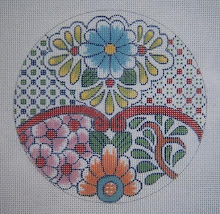
 I have shown this canvas a number of times in the past few years, I think, and also the bowl (Chinese Celadon, ca. 1820) from which I took the design. The bowl was a gift from my son a long time ago, and he asked me to design a needlepoint piece for him for his office. Since this time, he has gone into private practice and started his own law firm, and moved his office three times. Oh dear.I hang my head in shame, as the date on the canvas is 1996. I decided about a month ago not to touch any other stitching until I finished this one - and I did enjoy doing it. It is entirely basketweave, with outlining, of course, as no textured stitches would do on a design like this.It was never boring, as there were plenty of color changes to move on to when I got tired of one activity - could just go to something else. If I tired of outlining, I could then work on the background. It was very very rewarding to realize I had finished one of my large, classic pieces (15" diameter on 18 mesh canvas), that will still be beautiful and "in style" many years from now. Nothing trendy here, just timeless elegance, as are the Oriental porcelains. It is actually, the ONLY one of my classic big pieces I ever finished. I've had hopes of doing "Nellie's Imari," but that won't happen. When I was wholesaling nationally, I really got tired of looking at them, so never had any desire to stitch one. I remember when Marnie Ritter (Fessenden in the '70's) was teaching via EGA on one of my smaller Celadon pieces - beautiful job of enhancement before that was being done! - she graciously reserved me a canvas and kit when she was in San Antonio at the Yarn Barn. I loved sitting in on the class that week, but declined the stitching, as I told her I had painted and inspected so many of them (close to 300, as I remember,) that I couldn't bear to stitch one too. Now I regret that I didn't.I used DMC floss on this canvas, as I started it before I had seen the silks now available, but the cotton did a beautiful job. Also, I had the advantage of the gorgeous Kreinik 002V braid for the "coins." Back in the 70's, when I was producing so many of the Imari, Celadon, etc., we had nothing but Persian wool and no metallics. YUK.This photo was taken in haste, and with not so good light - but I wanted to send Joe the pic to assure him this is really really finished. It will need light blocking - and then off to a wonderful framer for a double mat and non-glare glass. I'm sure it will have a place of honor in his office!
 I had resolved about five years ago, when my son once again asked, to finish this canvas for him for his impending birthday - but, once again, put it away without doing it. I found it in one of the deep layers of a box I was investigating a few days ago (his birthday has just now passed again), and actually found the threads for it as well. It's much farther along than I remembered, so is actually "doable." This picture is upside down, but I only just now noticed it. It's so busy, it doesn't really matter for this purpose, except that the pomegranites in the center look rather strange. (symbol of fertility). Anyway, about 14 years ago, he gave me for Christmas a wonderful collection of antique porcelains to jump start a new design venture for me. This gorgeous Chinese Celadon bowl, dated ca.1820, was in it. As he is the only one of my six children who loves my work and understands it, I gave him the choice of one that I would stitch for framing for his office. He chose this one, so I have kept the bowl as well to surprise him. I had apparently almost finished it when he started his own law firm with his two law school roommates - and I didn't think this one would do for the new office, so put it down for a while. A very long while. Oh dear.
 The pomegranites I chose for the center of the canvas in this adaptation were inside the bowl in the center. A beautiful detail! the black spots are flaws in the glaze. I took the main part of the canvas design from the outside of the bowl. The next picture shows the butterfly - which is the symbol of bliss and fidelity for marriage. I think maybe this bowl was intended for a wedding present/blessing, as it also has the "coins" for prosperity.
 I was looking at this last night, and amazed at the fact that pre-digital camera/computer, color copier, etc. for over 35 years I did everything totally freehand. I'm not really sure now that I could start from scratch with a piece like this bowl and make it look right. I have become lazy and spoiled, and I think it's ruined my drawing skills. Hand/eye coordination isn't what it used to be. Oh well. Time marches on.
 The next picture shows the center of the canvas mostly stitched - still upside down. It's amazing how the stitching brings a canvas to life.
  This canvas is done entirely in basketweave, as it's way too busy for any other kind of stitch. The first "coin" picture shows it not yet finished, as I haven't done the outline yet. Fortunately, although most of the outline was already done on this canvas, I hadn't worked but a tiny bit of one of the coins in gold. I had to take it out, as it was way pre-002Vintage gold, and entirely too shiny and bright. The V braid (#12) is perfect - has just the right "gleam" of gold Again - notice how the stitching fills up the canvas and brings it to life. This used to be the wonder of stitching the painted canvas! Also, as a designer, we were always aware of what we called "entertainment value." That is, a good balance between design for challenge, and background for relaxation and rather mindless stitching. I never liked outlining, but my sister did. She hated backgrounds, but I preferred them. I had four more children than she did, so needed more decopression and nerve steadying..
 Doing outlining was an exercise in self-discipline for me. Thank goodness I had already done this part of this canvas when I put it away.
 The last picture is one segment with a butterly - almost finished with background, etc. Again, it's amazing how a painted canvas comes to life with the stitching - this is what keeps us going just a little bit farther. My reward now today will be to stitch more on Joe's Celadon AFTER I finish my painting that has to be done. He's on vacation now on Cape Cod - and will be very pleased and surprised when he gets back - assuming he'll be gone his usual two or three weeks.
 Almost 40 years ago, when I first began interpreting Oriental porcelains into needlepoint design (primarily the Chinese and Japanese of the mid 19th century export type) I became intrigued by the fact that there were so many repetitions of flowers, bugs, leaves, and other symbols in these beautiful pieces - so set out on another course of study into the meanings of these things. This morning, digging in a box of old canvases, I found this one - one of my very favorites, as was the oval shaped, footed compote that inspired the design. (dated ca. 1820) The first study I did years ago revealed that Celadon was the oldest known porcelain glaze, and that it originated in Korea - and went to China via a kidnapped Korean. Recently I have read otherwise - that it actually developed in China. I don't know. Anyway - this slightly bluish green is my favorite color! The design features the grasshopper (good luck) and the peony, which is the symbol for spring and also for wealth and nobility. The camelias, for winter, are also shown - and the "veins" on the background are the veins of the lotus leaf (water lily). The lotus is the symbol of summer. The border is the conventionalized "ocean waves" which is a pattern used by both Chinese and Japanese.
 Also in this box, I found a crumpled canvas that is almost finished in the stitching, and destined for my son, who gave me this lovely bowl about 14 years ago. (dated ca. 1850) The butterfly is the symbol of joy and fidelity, and also shows a "coin" which is for prosperity. Butterflies are rather prevalent in Chinese art - embroidery as well as porcelains. The inside of the bowl displays a typical symbol in Chinese art - the peach for immortality, and the pomegranite for fertility. I thought the whole thing would be quite a suitable choice for this son, as he had just taken the giant step and started his own law firm. I really must get busy and
  finish the canvas for
  him. He has probably forgotten about it - but it did take me 8 years to finish his dodo bird pillow. Oh well. He is used to his mama's strange ways. I might also give him the bowl to display with the stitched canvas, which will probably be framed.
 I have shown this canvas a number of times in the past few years, I think, and also the bowl (Chinese Celadon, ca. 1820) from which I took the design. The bowl was a gift from my son a long time ago, and he asked me to design a needlepoint piece for him for his office. Since this time, he has gone into private practice and started his own law firm, and moved his office three times. Oh dear.