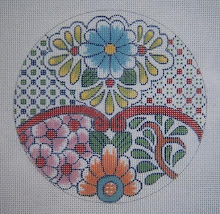
Showing posts with label Imari in Needlepoint. Show all posts

Wednesday, July 07, 2010

PLAID! and Old Imari Photos

I have finally spent a few days going through boxes that have been in the garage for three years, since I moved out of my house, and have found buried treasure again in the form of photos I thought were lost - of some of my favorite canvases I painted almost 15 years ago.

I did find the companion to the round Imari I showed in a post recently. It was my favorite of the two plates I had bought, but it disappeared for a while.

This one has cranes (I don't remember the symbolism right now in Japanese art) and also the Phoenix, which is the symbol for the "Empress." I adapted these two designs from plates dated ca. 1820 - beautiful things.

ADDENDUM: I finally found my list of symbolism, made long ago when I was designing from Chinese and Japanese antique porcelains. The Crane is a symbol of longevity and literary achievment - I like that one!!


Next of importance!!! As I have continued to have much interest in plaid and how to set up and stitch these wonderful patterns in needlepoint, I finally took a few days to update, revise, and add more pictures and color to the book I did about six years ago. At that time, I had no computer, and no way to put much color into it. Also, I've learned more about the terminology, etc., which is an interesting bit of history.

Anyway, this is now on my web page, ELEGANT WHIMSIES, in the form of an "E-Booklet." This means that it is immediately delivered upon purchase, and you may download and print it out yourself.


This is a good thing, as it's a fraction of the cost of the book that has to be printed and cover and coil binding applied - and then mailed out. I did this as Chapter I, which is basically how to stitch plaid, beginning with simple gingham checks, and then creating your own original plaid patterns by simply manipulating the width and colors in the "stripes."

Chapter II is in the works now, and will be a little more advanced, giving instructions for adapting and setting up projects with actual existing plaids (called "tartan" in the U.K., where the word "plaid" means a blanket thrown over the shoulder in the Highland Scots dress). I'll finish this chapter after I'm done with some painting that is lagging far behind.

Sunday, June 27, 2010

Tyler and Tartan

One doesn't have much to do with the other - but I'm attempting to explain my lack of enthusiasm and blogging the last two weeks or so. It seems that I'll be moving back to Tyler, after many years, and am delighted - but do dread the upheaval again.

I've packed up to move from one residence to another three times in the last few months, and am worn out, crabby, and just plain mean at times. I can't find anything, and it's maddening. However, as long as my computer works, and I have my coffee maker, paint brushes and plenty of canvas and something to stitch, I'll survive one more time. The Imari isn't the first one I did - I can't find a picture of it right now.

I started out in Tyler in 1969 when a woman brought me a gorgeous Imari saucer and asked me if I could put it onto needlepoint canvas for her. That was a long time ago, and I have continued to design from the antique porcelains whenever I run across something magnificent. This is from a plate my oldest son gave me in 1995. There were two of them, but I can't find a picture of the other one.
The Alpine Meadows tartan is almost finished - and needs a bit of light blocking with a steam iron. I've really enjoyed working on this one! Incidentally, I just posted a tutorial on stitching gingham checks on a circular shape over on Freebies, etc.
The ladies in the U.K. are amazed at the terminology we use - I was told in a comment that all of this is "tartan" and they've not heard of the term "plaid." I had researched this in curiosity a while back - and it's true that they are all one and the same - woven fabric with a pattern created by stripes horizontal and vertical meeting at 90 degree angles are referred to as "TARTAN." Interesting!!

Saturday, November 22, 2008

Japanese Art: More Design and Adaptation

Adapting a design to needlepoint canvas is a matter of also researching the origins of that design. It is important to understand colors, symbolism etc., so as not to leave out anything important, or to emphasize something that isn't. Japanese art, particularly the antique porcelains, has been the mainstay of my portfolio since I first began painting needlepoint canvas.

This picture is of a woodblock print of the great artist of the Edo period, Suzuki Harunobu. (1725-1770) After centuries of warfare and unrest, Japan had finally settled into peace and productivity, and arts begain to flourish. Harunobu was the first designer of woodblock prints
to use a series of blocks to apply multiple colors onto a rice paper ground. He primarily made images of beautiful women and Kabuki actors. More typical of this period was a lot of negative space, which gave a feeling of serenity. (this particular print is filled, however)

I never worked from these wood block prints, as I don't do people well, and am better at doing my own thing. Gail Hendrix, however, has done some lovely canvases from them! It's easier to really appreciate and understand her design work and adaptations, knowing the source. Be sure to visit Chilly Hollow, where Jane is stitching one of Gail's canvases at the present time. Lovely thing, it is!.

Of course I had to investigate the porcelains of the period, and found the gorgeous Kakeimon, which was produced in this time period - by a man who learned from a Korean potter after a deposit of the pure white kaolin porcelain clay was discovered. There was a lot of kidnapping of Korean potters in those days, as their work was superb and they knew many secrets - and Japan was late to begin producing pottery. The Chinese had already been doing it for centuries before.

I wasn't able to do but one or two pieces in needlepoint from this style, as the design elements are rather small, and with the amount of negative space left to show the beautiful snow white of the porcelain body and glaze, it would have been extremely boring to stitch. Small pieces, even on 18 mesh canvas, were not an option, as the detail of the little motifs would not have stitched well.
In the next century, the Imari was produced and marketed - and by the early to mid 19th century, some totally gorgeous ware was made to export to the western markets. This is what I enjoyed most in my designwork. Not only is it beautful "organized chaos" with little or no negative space, but it was a joy to adapt to canvas and a challenge to maintain the design elements and put them onto canvas so that they would stitch properly. This canvas is one of a pair - the other had cranes on it, but I have lost the picture, as well as the plate I designed from. The date on them was ca. 1820. I had to make the design on canvas 15" diameter on 18 mesh in order to get all the small and significant elements.

The central "peach" (immortality or longevity) is one of my favorites. On the porcelains, it is conventionalized to usually the half navy, and half diaper pattern as on this one. The six divisions is typical of this period, and is an ancient format that also traveled the silk road through the Ottoman Empire to Spain to become the Spanish Talavera - which was Maiolica, the in-glaze firing of color into the lead white glaze that covered the red clay body - in imitation of the white of the Japanese porcelains.

The rectangle is a little over a quarter section of a pillow I designed from an Imari bowl - again, mid 19th century. It had a pedestal on the bottom with the design I took for the border. The central "flower" was in the bowl itself, and the fretwork was around the inside of the bowl. The rest of the design was on the outside of the bowl - beautiful thing! ( I sold it a while back to raise funds to buy more antique porcelain.)

Anyway - this is how a needlepoint designer goes about adapting a design from a source! I'm doing the same thing these days with the Pueblo pottery, but have much research to do first - I'm especially intrigued with the "fetish" critters of the Zunis.

Thursday, July 31, 2008

TIF Challenge August - and Imari!

Beautiful colors for this month! Although it isn't yet August here. (tomorrow!) My first thought immediately was the Imari colors from the Japanese porcelains from which I designed my needlepoint canvases for so many years long ago. The colors will be glorious also in my new obsession - the embellished crazy quilt in needlepoint. As these colors are some of my favorites, although I favor the burgundy showing on my screen rather than the "rust" on the Imari, so I have lots and lots in my stash. I have shown this piece before - "Nellie's Imari" but will show it again, to illustrate. This is my favorite of all the Oriental porcelains I painted, and is the only one I have a copy of. If I ever achieve some semblance of "balance" in my life and work, (the August theme) maybe I'll take time to stitch it. My children assure me this won't happen - the balance part, anyway.

Wednesday, March 26, 2008

Looking Back!

This past week, reality has finally sunk in, and The Yarn Barn of San Antonio will no longer belong to my good friend Bobbi Ravicz. A major part of my life for the last 36 years will be no more, and I'm feeling awrfully sad. Coincidentally, while looking under the bed for a vial of beads I had dropped, I discovered the box containing this picture - a very long time ago it was taken. I had no idea what was ahead at the time, except my beautiful Jennifer, who was born a few days after the picture was taken. Jennifer is now almost 37, and a mother herself. (and I don't look like this any more) This was the first publicity pic of me just before my newspaper column was published for the first time. It was at the end of July, 1971, and I had not even met Bobbi yet, as at the time she was happily selling Paternayan Persian yarn out of her garage to weavers. A few needlepointers had found her by then, however, and were buying yarn. Inge Woolley was content knitting beautiful garments for the Neiman Marcus Dallas Trophy Room and managing her "Inge's Knit Shop" at Snyder Plaza. What a ride we had ahead of us, and we didn't suspect a thing! I had met Inge while shopping there, and she was the first shop owner to really admire the Imari designs, and understand the elegance of them. She placed a nice order, so I had to figure out quickly how to assembly line copy paint my canvases. Others I had shown them to had told me nobody would ever buy the things. Anyway, my article was published in Abilene in early fall, and by the next spring it went on to the San Antonio Express and then to the Dallas Morning News, where it became "Creative Woman." I wrote an illustrated article about the Imari canvases I was designing and painting, and the flood gates opened. The newspapers in Houston, Amarillo, Phoenix, and Denver had also bought this column - and the demand for the Imaris and other Oriental porcelain reproductions became overwhelming! (Celadon, Canton Rooster, and Rose Medallion) A woman in San Antonio went to Bobbi with the article, and asked her to get the canvas for her - so Bobbi and I met, and soon after, she opened her first Yarn Barn on Broadway street in S.A. We became instant "old soul" type friends the first time we met face to face when I went there to teach a class. I couldn't produce the canvases fast enough, so went back to Dallas, and convinced Inge and her partner at the time in the shop that they needed to form a company to produce and market my designs - so Creative Needle was born. (and so were two more of my children, for a grand total of six.) Shortly afterward, the column was purchased by United Feature Syndicate - and we were off to the races - and what a glorious run we have had. Bobbi is closing, but Inge and I are still playing with our paints and stitching, and she still wholesales - what else would we be doing? We are grandmothers now. Speaking of time passing - all that hair isn't mine. We wore "wiglets" then and also false eyelashes. Oh well. We thought we were pretty cute.

Thursday, January 24, 2008

Needlepoint from Antique Porcelains


This is one of my favorite designs of all time that I have done in my life's work as a needlepoint designer. The major body of work in the 70's was drawn from plates and bowls from the period of about the mid 19th century, and earlier when I could find it. Besides the Japanese Imari, which I loved, there was also the Chinese Celadon, Rose Medallion, Canton Roosters - and even a bit of Gaudy Welsh. A lot of research into symbolism and even into the glazing methods made it all the more fascinating. This piece is the one I will do if I live long enough, as I have never actually finished one of my old, classic designs. A long time friend of my mother's brought me a plate sometime in the mid 70's - that she had purchased in Japan in about 1920, and wanted me to paint a canvas for her - I did, added it to my wholesale line, and it became "Nellie's Imari." Beautiful thing it was. I painted this canvas about ten years ago, as my sister had stitched one waaaay back then, (and loaned it to me to copy one for myself) - but all in Paternayan Persian, which is what we had at that time. Now we have gorgeous silks and metallics to use, so I'm glad I waited. Maybe I will assign myself this to stitch simply because I want to sometime this year. I don't often have that luxury!!